Catalogue Request Form…!

Excessive foam creates more than just aesthetic problems. It leads to uneven dyeing, jams machinery, wastes water and energy delays timelines – and huge financial and material losses.
This is where anti foaming agent is necessary. These agents solve problems without causing foam disruptions and ensure consistent quality and optimized production efficiency. In this article, we describe how anti-foaming agents improve textile processes, cost and quality of output across the textile applications.
In textile manufacturing, liquid processes often generate foam due to the interaction of chemicals, air, and mechanical agitation. Foam can trap air bubbles on fabric surfaces causing defects and process inefficiencies.
An anti-foaming agent commonly known as a defoamer—is a chemical additive that prevents or reduces foam formation. By breaking down foam quickly or stopping it from forming altogether, anti-foaming agents stabilize processes and increase efficiency – whether in dye baths, printing machines or finishing lines.
Foam develops when surfactants, dyes or chemicals combine with air in high-speed agitation, or mechanical processes. The foam may be invisible but interferes with critical operations resulting in inefficiencies and quality issues. The main problems foam causes are:
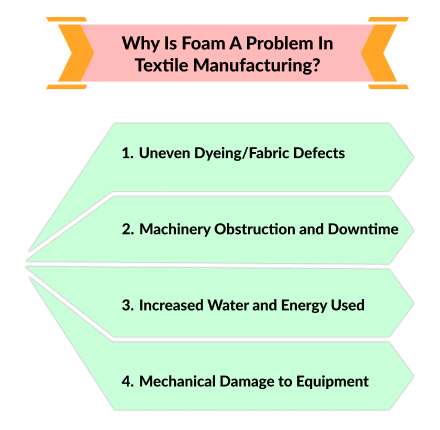
Foam forms air pockets on the fabric surface during dyeing that prevent even distribution of dyes and chemicals. That creates patches of uneven colouring and decreases the aesthetic value of textiles. Such flaws would cause more rejection and material waste for producers who want to fulfil high-quality requirements.
In high-speed machinery, foam obstructs pipes, nozzles and filters, causing downtime and production loss. Machines sometimes have to be stopped completely to clean, which causes downtime and lost productivity. Frequent maintenance imposes additional operational costs and delivery time pressure.
Trapped bubbles and chemical residues from foam-related disruptions may require additional rinsing and cleaning cycles. This not only wastes huge amounts of water but also more energy, raises production costs and decreases the sustainability of the plant.
Foam causes cavitation in pumps – pressured air bubbles collapse and damage the pump walls and impellers. This eventually wears down and requires repairs or replacements.
Controlling foam effectively is critical for textile manufacturers to achieve smooth processes, maintain high-quality output, and ensure cost efficiency.
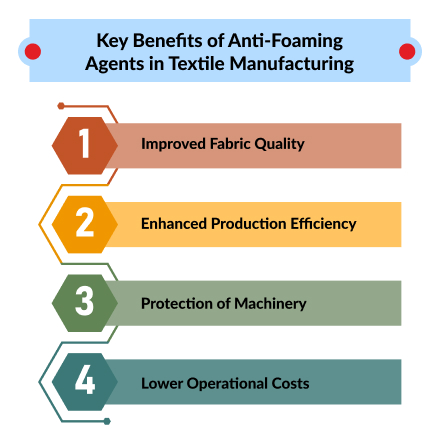
Foam leads to poor finishing or uneven colour patches. Foaming agents blow out air bubbles to remove them so colour and chemicals can be applied to the fabric. This produces consistent industry standard quality output.
Foam blocks high-speed textile machines and producers must stop production for maintenance or cleaning. A foaming compound shortens foam delays so equipment can work at maximum efficiency. So faster production gives more output and lower expenses.
Foam buildup worsens the wear on the machinery. Cavitation or the collapse of air bubbles inside pumps, pipes and gear may result from it. Anti-foaming products reduce maintenance costs, equipment life and such risks.
Rinsing, downtime and maintenance of foam are additional costs. These inefficiencies are eliminated with anti-foaming agents that save water, energy and money on equipment repairs or replacements. The manufacturer might eventually save money.
The types of anti-foaming agents help textile manufacturers choose the right solution for their process. These are:
Anti-foaming agents containing silicon are among the most common because of their high efficacy, stability and versatility. These are a mixture of silicone oils and hydrophobic particles that perform best in aqueous systems like dye baths and washing.
Find out more benefits and applications of silicone defoamers in textile manufacturing. See our article for more on how these agents deal with foam problems. Read here: Benefits of Silicone Defoamer in Textile Manufacturing.
Such agents may contain natural ingredients, fatty alcohols, or mineral oils. These are suitable for procedures in which silicone residues may impair the chemical compatibility/quality of the final product.
The best anti-foaming agent is dependent upon the textile process and operation. Consider the following factors:
Anti-foaming agents are needed in textile manufacturing but they also play a key role in other industries.
Anti-foaming agents have an important industrial application outside of textiles. Read more on how these agents improve various industrial processes in How Antifoaming Agents Enhance Industrial Processes.
Foam interrupts processes increases costs and compromises quality during dyeing and printing. Anti-foaming agents remove these difficulties, improve efficiency, and protect machinery & textile quality.
At Colurinn we understand how Anti-foaming agents play an extremely important role in textile production. View our range of quality anti-foaming agents for textile and allied industries. Let us make your production batches more efficient, quality and consistent.
A. They can be added directly to the processing bath or applied as part of a continuous system, depending on the process requirements.
A. Anti-foaming agents break the surface tension of foam bubbles, causing them to collapse. They also prevent the formation of new foam by altering the liquid’s surface properties.
A. Common types include: Silicone-based agents: Effective across a wide range of conditions.
Non-silicone-based agents: Typically mineral oil or polymer-based.
Water-based agents: Suitable for eco-friendly processes.