Catalogue Request Form…!

The right acetic acid substitute is an important decision for textile manufacturers who want to optimize dyeing processes while considering sustainability and economic aspects.
This article discusses acetic acid replacement in textile production, types like citric acid and formic acid, pH control, environmental impact and fabric compatibility. We also discuss acetic anhydride alternative options and how Colourinn Auxiliaries tailors solutions to suit your dyeing process and industry standards.
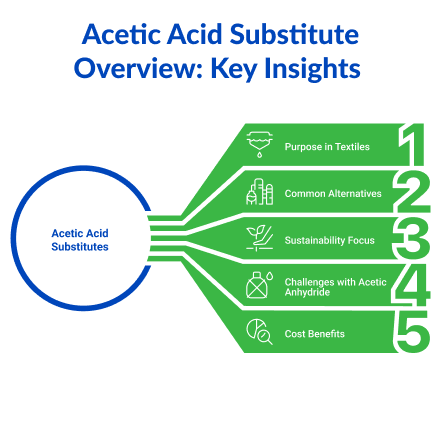
In textile dyeing, acetic acid adjusts the pH of dye baths to improve dye uptake and color fastness. However, its strong odour, corrosiveness and environmental concern make acetic acid substitutes necessary. These alternatives maintain pH control, fabric quality and sustainability goals. The right acetic acid replacement allows manufacturers to achieve vivid colors, low cost and low ecological impact – an important decision in modern textile processing.
Acetic acid has a pH 4-6 environment that encourages dye-fibre bonding, especially for acid dyes used on wool, silk and nylon. This ensures uniform colour and durability, but causes skin irritation and wastewater pollution. Acetic acid substitutes solve these problems with similar performance.
Also, read more about dyeing process at: Why Dyeing is an Essential Process in Textile Manufacturing
Several different substitutes for acetic acid exist with properties suitable for textile applications. The following are the most common substitutes.
Citric acid is a mild eco eco-friendly replacement for acetic acid. It adjusts pH & is less corrosive than acetic acid. Key features include:
Formic acid is a low cost alternative to acetic acid that needs lower dosages to obtain the same pH control. It is used in textile processing. Benefits include:
Sodium acetate is a salt of acetic acid used in pH buffering. It works best on delicate fabrics. Advantages include:
Green acids such as Colourinn’s Texacid Eco are biodegradable acetic acid substitutes for textile processing. They offer:
There are limitations on acetic anhydride in some regions, for example, India, which makes alternative acetyl chloride or propionic anhydride possible for acetylation processes. These alternatives are:
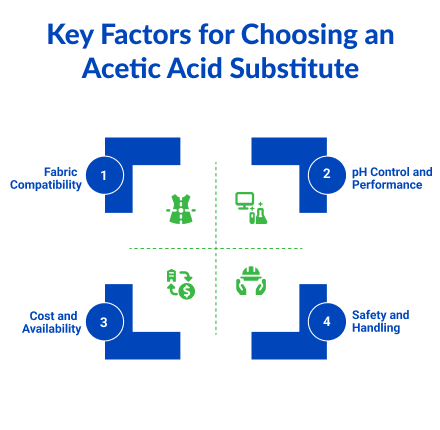
Several factors determine this choice: the substitute should meet production goals and fabric requirements. The following are considerations to help you make a decision.
Correct application of acetic acid substitutes is important both for even dyeing results and for the best possible utilization in textile processing.
This method dips fabrics in a solution of the acetic acid substitute (citric acid / sodium acetate) and passes them between rollers to remove excess liquid. It affords evenness of distribution over the fabric surface, so is suitable for continuous dyeing processes. At least keep the pH between 4-5 and avoid residues like oils or surfactants that may hinder absorption.
In the exhaustion method for batch dyeing the fabrics are immersed in a dye bath into which the acetic acid replacement is added progressively. This allows the substitute to be absorbed slowly such as formic or green acids, thus ensuring uniform dye uptake. Particularly good for batches of small quantities or for delicate fabrics such as silk where precise pH control is needed. Monitor bath temperature (typically 50-80degC) to improve absorption efficiency.
Spraying applies the acetic acid substitute onto the fabric areas generally used for spot treatments or limited production. It’s less common because of possible unevenness but suitable for specialty textile or localized dyeing. Avoid overuse that results in patchy results – calibrate precisely. This method is practicable with acetic anhydride replacements for acetylation; however these must be handled carefully regarding their reactivity.
This method uses foam to deliver acetic acid substitute – no water or chemical needed! It’s becoming popular for sustainable production-especially with green acids. Foam application wastes little and provides even coverage especially for light-weight or knitted fabrics. Adjust foam density & curing conditions to maintain substitute effectiveness.
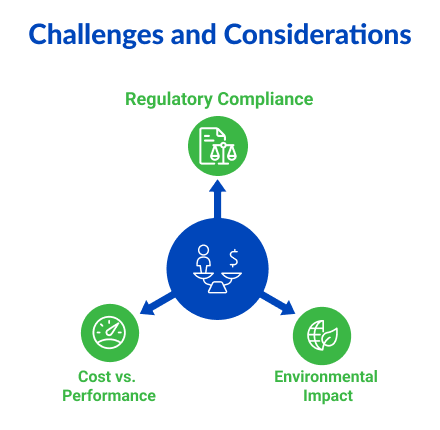
Acetic acid substitutes offer advantages but are challenging to manage in textile production. Meeting these ensures optimal performance and industry standard compliance.

At Colourinn Auxiliaries, we empower textile manufacturers with the right acetic acid substitute to achieve vibrant, durable fabrics. This guide has reviewed key substitutes such as citric acid, formic acid and green acids for pH control, sustainability and cost-efficiency. Our expertise in acetic anhydride alternative and replacement solutions ensures quality results for you.
Ready to upgrade to acetic acid substitutes for dyeing? Contact Colourinn Auxiliaries to know more about our innovative Texacid Eco and other solution. Find out how we can replace your textile production with high-performance alternatives today!
A. The best Acetic Acid Substitute for dyeing in textiles is one that maintains pH control, improves color fixation, and is environmentally safer than traditional acids.
A. To choose the right Acetic Acid Substitute for textile use, consider factors like pH level, fabric compatibility, dyeing performance, and environmental impact.
A. When chosen correctly, an Acetic Acid Substitute can maintain or even improve dyeing quality in textiles, ensuring vibrant colors and better fabric care.