Catalogue Request Form…!

Want your fabrics to feel softer, last longer & perform better? The right silicone softener makes textiles soft, durable and functional in various fabrics.
How to choose a silicone fabric softener for cotton, synthetics, wool & more – by fabric type, desired finish and application methods. Also covered eco-friendly options and silicone-based fabric softener benefits, delivered by Colourinn Auxiliaries – delivering tailored textile solutions for various industries.
Silicone softener is a textile finishing agent which is based on polysiloxane compounds which cover fibres to confer a good softness, a good slidability and an adequate elasticity.
Unlike the traditional softeners, silicone fabric softener is wear-resistant after multiple wash cycles. These softeners cause less friction between fibres and make fabrics plush and comfortable.
The materials are used for clothing, home textiles and technical fabrics with a premium hand feel and performance.
Its Si-O-Si backbone gives silicone-based fabric softener flexibility, thermal stability and lubrication – soft but resilient fabrics. They also provide anti-static properties and, in some cases, water repellency – important properties for textiles of today.
The selection of suitable silicone softener guarantees that your fabrics fulfil the requirements of consumers regarding comfort and durability.
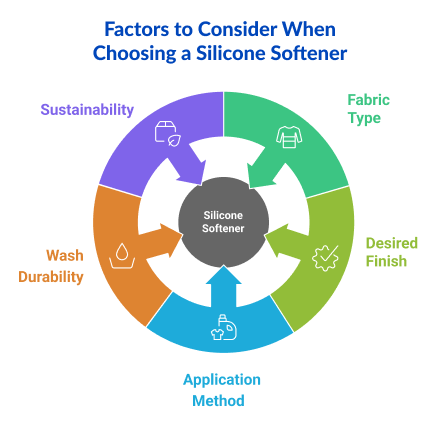
How to choose a silicone softener varies. Knowing these will help you match the softener to your fabric and production goals.
Different fabrics need different silicone fabric softener formulations:
Your finish controls which silicone-based fabric softener to use:
What kind of silicone softener you apply influences how it performs:
For fabrics that will be washed frequently, select a silicone fabric softener having high silicone-based fabric softener durability, such as block copolymers or epoxy-modified types.
And eco-friendly silicone softener options like bio-based or fluorine-free reduce environmental impact, and meet regulatory requirements such as ZDHC.
Textile finishing is an important process of the textile manufacturing process, to know more about finishing visit: Textile Finishes: Different types of Finishes for Textiles.
| Factor | Consideration | Best Softener Type |
|---|---|---|
| Fabric Type | Cotton, synthetics, wool, silk | Hydrophilic, amino, epoxy, nano |
| Finish | Silky, glossy, matte | Amino, block copolymer, hydrophilic |
| Application | Padding, exhaustion, spraying | Varies by method |
| Durability | Wash resistance | Block copolymer, epoxy-modified |
| Sustainability | Eco-friendly, biodegradable | Fluorine-free, bio-based |
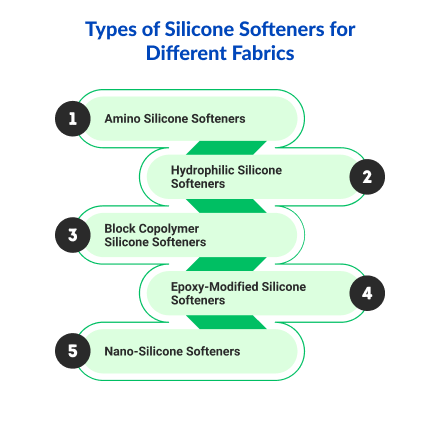
Each silicone softener type is for particular fabrics and applications. Here’s a breakdown:
Amino silicones are the go-to for a plush feel. They bind well with fibres; therefore, they work best on cottons and cotton blends for T-shirts and bed linens. They will yellow at high temperatures but should be avoided with light-colored fabrics.
Hydrophilic silicone fabric softener has moisture-wicking and softening properties suitable for activewear and towels made of cotton or polyester. They are softeners for breathability & comfort.
Block copolymer softeners contain silicon and some other polymers that impart elasticity and silicone-based fabric softener durability. These are great for upholstery & sportswear requiring extra softness.
Epoxy-modified softeners are all about durability and a dry feel, and they work best on synthetics such as polyester used in uniforms or automotive fabrics. They resist alkali and shear forces.
Nano-silicone softeners enter fibres deep to impart internal softness without impairing breathability. They’re suitable for silks or knitted clothes.
Correct application of a silicon softener yields maximum benefits. Follow these tips:
The wrong silicone softeners can yield subpar results. Avoid these pitfalls:
We at Colourinn Auxiliaries understand that the success of the textiles in terms of their “luxurious Touch” & “performance” depends on the right selection of Silicone Softener.
So far, this guide has shown you how to select the right silicone fabric softener for your fabric type, finish, application method and sustainability requirements. From amino silicones for cotton to nano-silicones for silk, with our silicone-based fabric softener solution, you get comfort with durability.
Ready to soften textiles with the ideal silicone softener? Explore new eco-friendly softeners from Colourinn Auxiliaries. See our solutions for softness, durability & customer satisfaction at Colourinn. Create extraordinary textiles with us!
A. A silicone softener is a textile finishing agent that improves fabric softness, elasticity, and smoothness. It covers fibers with a thin silicone layer, enhancing the hand feel without compromising breathability or appearance
A. Yes, silicone softeners are suitable for synthetic fabrics like polyester. It reduces static, improves softness, and adds flexibility, making garments more comfortable and wrinkle-resistant after processing
A. Dilute silicone softener as directed and apply via padding, spraying, or exhaust method. Ensure uniform application, proper drying, and curing for optimal softness, smoothness, and fabric performance