Catalogue Request Form…!

Textile finishing changes raw fabrics into ready-to-wear materials meeting everyday use and market demands. In this informative guide, we will take a look at popular textile finishing solutions for cotton, polyester and their blends.
Get to know what is finishing in textile what finishes are classified in textiles and types of finishing in textiles like chemical and mechanical methods. You’ll find practical details on the textile finishing process of each fabric type based on industry practice to enable manufacturers to achieve durability, comfort and performance. Discover how Colourinn supports these processes with reliable auxiliaries.
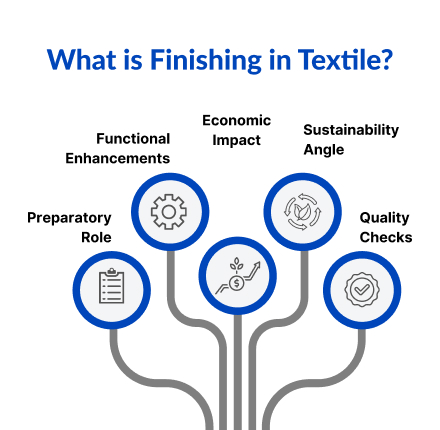
Finishing is the last operation in textile production; here, treatments are applied to upgrade the fabric properties and performance. This step corrects problems from earlier processes such as uneven dyeing and stiffness, and adds value through feel, performance improvements.
Industry experts define finishing in textiles as a combination of preparatory, dyeing and post-treatments according to end-product requirements. Cotton yarns for example absorb moisture whereas polyester threads resist static buildup.
The finishing classification of textiles groups treatments by durability, application method or purpose to enable producers to select options for specific fabrics. It dictates whether a finish will wash out or survive repeated laundries. Cotton needs to be semi-durable for everyday wear, polyester permanent for stability, and a mix if you want compatibility.
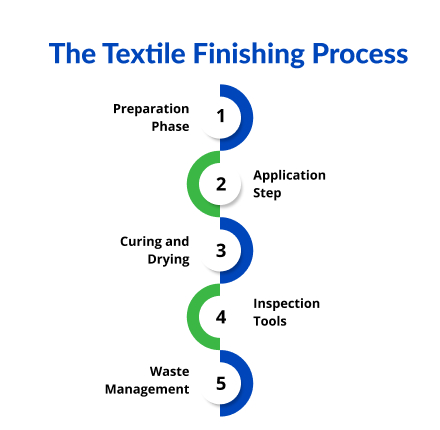
The textile finishing process has a specific sequence i.e preparation, application, curing and inspection. Mills begin by scouring clean fibers and finish with baths or machines. For blends this guarantees polyester’s slickness against cotton’s breathability, without separation risks.
The process also adapts to fiber blends where cotton impurities are broken down first by polyester-compatible resins. Timing matters; Polyester melts when it gets too hot.
Compounds used for chemical finishing of textiles change fibre properties such as resilience or repellency. This works well with cotton for mercerization, which swells fibres for lustre, and polyester for silicone treatments in textile that ease sewing. Blends need balanced formulas so polyester does not dominate the feel.
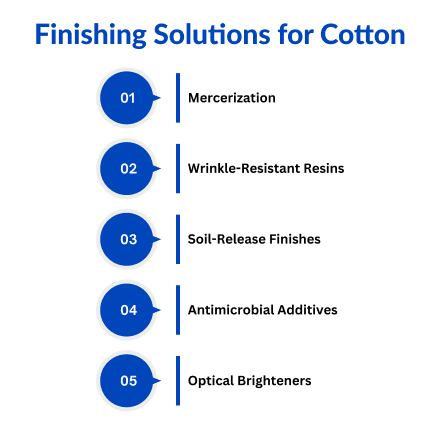
Cotton prized for breathability requires textile finishing that preserves its natural characteristics while being tough. Caustic soda mercerization increases yarn uptake and strength up to 20% tensile gain.
The stiffness from weaving is tempered by softening. Mills apply these in batch systems focusing on absorbency for towels or shirting.
Polyester is synthetic so textile finishing should stabilize heat-sensitive fibers and prevent static. Heat settings at 190-220°C fixes dimensions, so knits do not shrink. Anti-static sprays are used for comfort in activewear. ITMF industry reports recommend low chemical loads to avoid buildup on smooth surfaces.
Blends such as cotton-polyester (65/35) require textile finishing that matches fibers for example resins for cotton wrinkle control and silicones for polyester. Multifunctional chitosan finishes add antimicrobial properties and last 20-30 washes per PMC studies.
Processes such as pad-dry-cure guarantee an even penetration. PH 4-6 & concentrations (2-5%) are optimized for easy-care effect without stiffness.
We have explored how textile finishing changes cotton, polyester and blends through specific processes and finishes. These solutions provide the softness, strength and sustainability that global markets demand from understanding what finishing in textile to chemical finishing of textiles & mechanical finishes in textiles.
Need help refining your fabrics? Our textile dyeing auxiliaries and reactive dyes are available for all steps of the textile finishing process. For custom formulations or samples: contact our experts in bringing your blends alive!
A. Textile finishing is the final stage of fabric processing that enhances properties like softness, strength, appearance, and durability. It improves product quality and prepares fabrics for their intended use.
A. Textile finishes include chemical finishes (like softening, water repellency, and flame resistance) and mechanical finishes (like calendaring, raising, and heat-setting). They are also classified as temporary, semi-durable, or permanent.
A. Cotton finishes focus on softness, absorbency, and wrinkle resistance, while polyester requires heat-setting, anti-static, and dye fixation treatments. Blends use balanced formulations to match both fibers.