Catalogue Request Form…!


A blooming agent is a game-changer in textile processing, making colours deeper and fabrics more vibrant.
This guide explains what blooming agents are, how they work and their uses in textiles, from polyester to cotton. We’ll cover benefits like cost-efficiency and sustainability, industrial applications and how Colourinn Auxiliaries is a blooming agent textile pioneer.
Discover how these agents create richer, longer-lasting fabrics that meet modern industry demands.
A blooming agent is a textile processing auxiliary that increases dye uptake, resulting in deeper, more vibrant colours. By increasing the fabric’s refractive index, these chemicals make more light is absorbed, creating richer hues.
Used in blooming agent textile applications, they work on polyester, cotton and blends, aesthetics and functionality.
The magic of a blooming agent is in its chemistry. It interacts with fabric fibers through cross-linking and polymerisation, forming a strong bond that enhances dye penetration. This results in:
For example, silicone-based blooming agents give a soft feel, while resin-based ones improve durability.
Not all blooming agents are the same. Different types are for specific fabrics and effects in the textile processes. Here’s a breakdown:
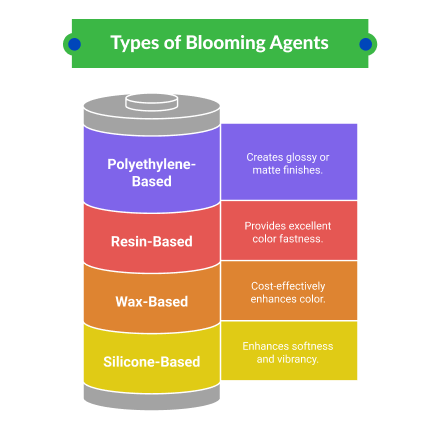
These agents give a soft hand feel and vibrant colors, popular for polyester and blends. Eco-friendly and versatile.
Wax-based blooming agents are cost-effective colour enhancers but lack durability compared to others.
Resin-based agents excel in colour fastness, colours don’t fade from washing or sunlight exposure.
These are for specific finishes, like glossy or matte effects and are used in technical textiles.
| Type | Pros | Cons | Best for |
|---|---|---|---|
| Silicone-Based | Soft feel, eco-friendly | Higher cost | Polyester, blends |
| Wax-Based | Affordable | Less durable | Casual fabrics |
| Resin-Based | High colour fastness | Stiffer feel | Durable textiles |
| Polyethylene-Based | Unique finishes | Limited applications | Technical textiles |
Blooming agents are the stars of textile processes, working on fabrics across industries. Their main applications are:
For example, a blooming agent can make a polyester jacket’s colours pop and withstand multiple washes.
Also, visit our Textile Finishing Chemicals solutions for eco-friendly and sustainable fabric enhancement.
Why choose a blooming agent for textile processing? The benefits are many, which is why manufacturers choose them.
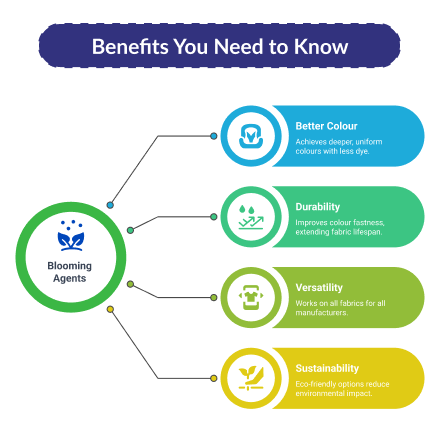
Blooming agents are used in many industries beyond textiles.
Choosing the right colour deepening agent depends on your fabric and goals. Consider these:
For example, Colourinn’s silicone-based blooming agents are perfect for polyester, for vibrant colours and a soft feel.
Applying the colour deepening agent requires precision for best results. Methods include:
Make sure fabrics are clean and pH 4-5 during application for maximum effectiveness.

Blooming agents are powerful but come with challenges:
The future of blooming textile solutions looks bright:
These trends will make these agents even more essential to textile manufacturing.
At Colourinn Auxiliaries, we master blooming agent technology to change textiles. This guide has shown how these agents increase colour depth, reduce costs and support sustainability in industries like fashion and technical textiles. We deliver vibrant, durable fabrics that meet your needs.
Ready to bring your textiles to life with top-quality blooming textile solutions? Contact Colourinn to learn more about our products. How can we help you with your textile production? Let’s create beautiful fabrics together!
A.Blooming Agents in the textile industry are chemical additives used to enhance fabric surface properties, such as softness, finish, and overall appearance.
A.Blooming agents are used in the textile industry mainly for enhancing surface finish, softness, ensuring uniform application of dyestuffs, coatings, etc.
A. Yes, most Blooming Agents used in the textile industry are safe and compliant with industry standards, ensuring both product quality and environmental safety.