Catalogue Request Form…!

Disperse dyeing is a specialized process for adding color to synthetic fibers (polyester, nylon, acrylic). In this article, we will discuss the science behind disperse dyes, the step-by-step dyeing process, parameters influencing dyeing efficiency and challenges & innovations. Whether you are in textile manufacturing, fashion or just interested in synthetic dyeing this guide will give a good grounding in disperse dyeing and its importance in modern textile fabrication.
Disperse dyes are a group of synthetic dyes that are specifically designed for dyeing the hydrophobic (“water-repellent”) synthetic fibres (polyester, nylon, acrylic). Disperse dyes are not soluble in water but remain a fine suspension or dispersion in the dye bath, unlike traditional dyes that dissolve in water. This helps them to penetrate the close molecular structure of synthetic fibres that resist dyeing by conventional means.
The very high temperature required for the binding of disperse dyes, usually between explains their success with regard to synthetic fibers. By this process, at high temperature, the dye molecules diffuse within the fiber, and are anchored there, to give bright, permanent colors. Disperse dyes find a particularly good application on polyester which is the most common synthetic fiber in the textile industry.
Also, Read our blog: The Use of Dispersing Agents in Textile Industries
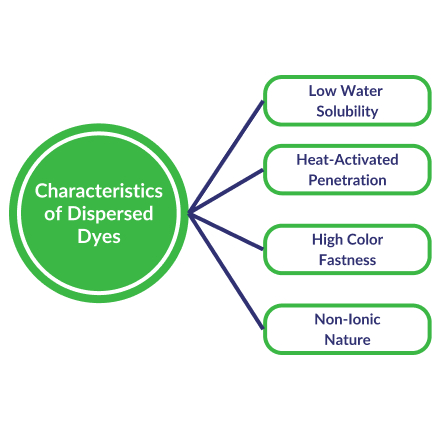
The molecular structure of dispersed dyes is designed to be small and non-polar, allowing them to diffuse into synthetic fibres effectively. Depending on their structure, disperse dyes are categorized into azo, anthraquinone, and triarylamine-based compounds, each offering a different shade range and stability. The majority of disperse dyes used today belong to the azo family, producing colours from bright yellows to deep reds.
The disperse dyeing process ensures that synthetic fabrics absorb dyes uniformly with good color strength. Because hydrophobic polyester and other synthetics are hydrophobic, high temperatures and chemical dispersing agents are needed for dye uptake.
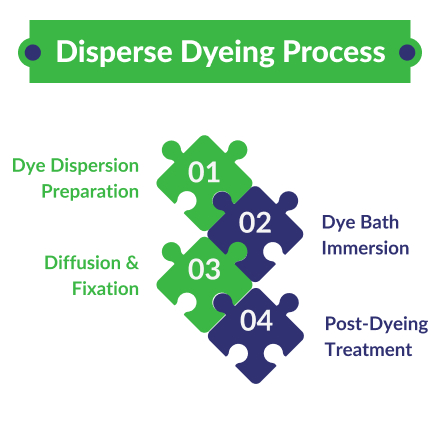
Different dyeing methods are employed according to the fabric type and production requirements. Most common methods use high temperature dyeing, carrier dyeing and thermosol dyeing (dye is fixed at high temperature without water immersion). Each method has advantages like less water usage or deeper colour penetration.
The effectiveness of disperse dyeing lies in the interaction between dye molecules and synthetic fibres. Unlike natural fibres, which bond chemically with dyes, synthetic fibres require a physical absorption process.

At Colourinn Auxiliaries, we understand the intricacies of disperse dyeing and the demands of modern textile production. Our high-performance disperse dyes for polyester are developed for deep color penetration, good fastness & eco-friendly processing. We innovate our dyeing solutions to abide by changing industry standards.
Custom dyeing solutions, technical support and sustainability are part of our promise to our clients for the best results in polyester dyes and other synthetic fabric applications. Whatever your field – textile manufacturing, fashion, industrial dyeing – Colourinn is the partner for brilliant, lasting colors. For even more about our products and technical knowledge, get in touch with our experts today!
A. Disperse dyeing provides vibrant colors, high wash fastness, durability, and is suitable for industrial-scale dyeing of synthetic fabrics.
A.The process involves suspending dye particles in water, heating the fabric to allow dye penetration, and fixing the color through diffusion into the fiber structure.
A. Common methods include high-temperature dyeing, carrier dyeing, and thermosol dyeing, each offers different benefits based on the fabric and dyeing requirements.