Catalogue Request Form…!

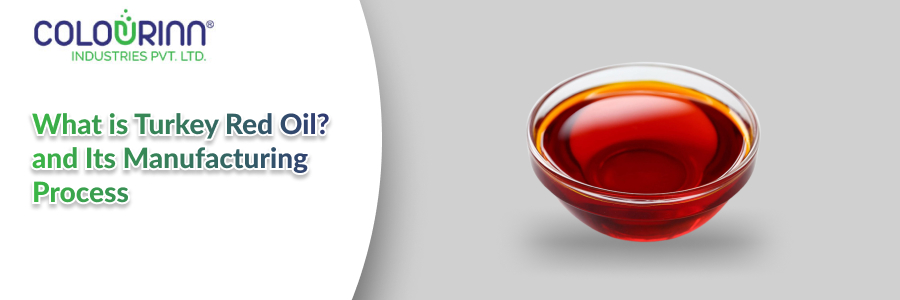
Turkey red oil (TRO), alternatively called sulfated castor oil, is an important industrial chemical. It is a derivative of castor oil, an industry standard in the textiles and cosmetics industries. In this article, we will explore turkey red oil in detail—what makes it special, how it’s produced, and why it plays a key role in many industries.
Turkey Red Oil is a pale yellow viscous liquid obtained by a chemical process. It mostly consists of sulfonated ricinoleic acid, derived from castor oil. This unique modification makes turkey red oil a valuable component in many applications.
An important characteristic is that TRO is a strong wetting agent It decreases the surface tension of water so it penetrates and spreads on fabrics. This helps dyes distribute evenly and increases color absorption.
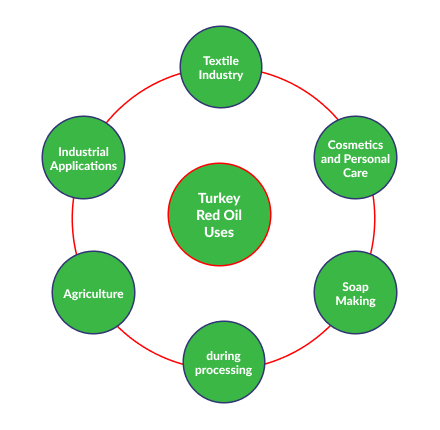
Because of its unique and rich properties, TRO is a versatile compound used in many different industries.
Learn about the Role of Enzymes in the Textile Industry in our article enzymes’ Role in the textile industry. This piece shows how enzymes – especially desizing – can change fabrics for dyeing or finishing.
The manufacturing process begins with castor oil obtained from the seeds of the castor plant Ricinus communis. The seeds are cleaned and pressed to express the oil that is filtered to remove other material. High-quality castor oil is the basis of turkey red oil and is critical for a quality end product.
this crucial step, the castor oil is sulfonated. This means adding concentrated sulfuric acid or sulfating agents to the oil. The acid combines with the hydroxyl group in the ricinoleic acid of castor oil to give sulfonic acid esters.
This chemical modification makes the oil water-soluble and suitable for applications requiring emulsification. The reaction is monitored as the amount of sulfuric acid added must be controlled lest the oil be degraded and the efficacy diminished.
The mixture is neutralized by an alkaline agent like NaOH after the sulfonation reaction. This helps stabilize the product and remove any residual acidity that may affect TRO safety and performance. The neutralization guarantees that the final product can be used safely in industries as well as in quality standards.
The neutralized mixture is washed several times to remove remaining acids, byproducts, or impurities. In this phase, water or brine solutions are usually added to purify. Purification is essential to get a clear TRO of good quality because any residual by-products influence the application performance.
The last step is filtering the oil to the desired clarity and consistency. This step removes any particulates and other residual stuff, leaving behind something that is pure and water-soluble. During manufacturing, quality control measures are in place.
That includes testing for pH, purity, and water solubility to ensure TRO meets industry standards and application requirements.
Read How to Make Turkey Red Oil: The Complete Guide to Turkey Red Oil Production & Use. This article explores the properties that make TRO a staple in the textile and personal care industries.
A reputable turkey red oil supplier is important when sourcing TRO. The reliable suppliers will supply industry-standard TRO that is free of contaminants. Choose a supplier:
As a leading Turkey Red Oil Supplier, Colourinn continues to provide sustainable and high-quality solutions to its esteemed clients across a range of industries.
We produce dyes and textile auxiliaries of the highest quality. Our deep knowledge of turkey red oil production and commitment to sustainable practices sets us apart in the industry.
Want to discover how turkey red oil can benefit your products? Get in touch with us for more details on our customized services & expertise.
A. The insulation materials utilized by cold storage are as follows: Polyurethane (PIR) This material is mostly applied as an insulation material which has remarkable insulating properties and mechanical strength, so that it avoids heat transfer and minimizes the loss of heat.
A. Turkey Red Oil is produced by a process called sulfonation, where castor oil reacts with sulfuric acid or a mixture of sulfur trioxide and water. This process forms a sulfonate group that gives the oil its emulsifying properties.
A. Turkey Red Oil should be stored in a cool, dry place, away from direct sunlight and heat sources. It should be kept in tightly sealed containers to prevent contamination and preserve its effectiveness.