Catalogue Request Form…!

Export-quality textiles must meet stringent global standards for softness, durability, and visual appeal. This article discusses why these qualities are attained with a cationic softener.
We’ll cover their unique chemical properties and how they improve textile performance in many fabrics. You’ll also read about their forms, such as cationic softening flakes and cationic fabric softener, their synergies with cationic resin softener systems, and how Colourinn develops tailored solutions for international markets.
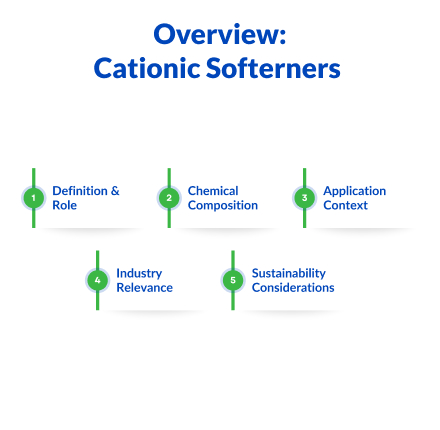
Cationic softeners are special chemical agents applied in textile finishing to give softness, smoothness, and/or flexibility to fabrics. These are positively charged surfactants, which can therefore also bond with the negatively charged surfaces of most textile fibers. This interaction is essential to convert stiff or hard materials into soft, high grade exportable products.
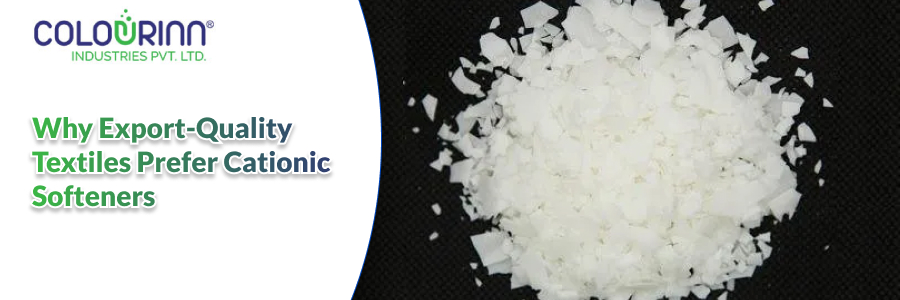
Manufacturers appreciate cationic softener versatility and efficacy. These are supplied in the form of cationic softener flakes and liquid cationic fabric softener for different production setups.
They are formulated from fatty acids or quaternary ammonium compounds compatible with most fibers while meeting global eco-friendly profiles, textile industry sources said.
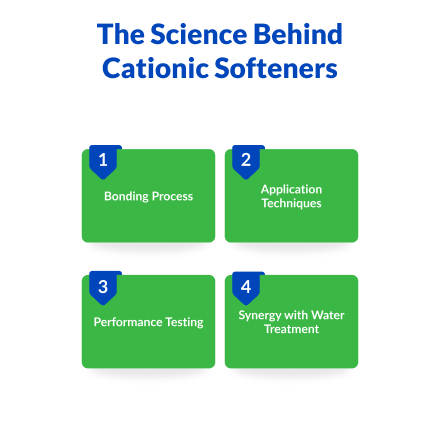
Cationic softeners work electrostatically with fabric fibers. The positive charge of the cationic molecules attracts the negative charge on fibers such as cotton or wool to form a thin lubricating film. This lowers interfiber friction, giving a softer, smoother feel.
Export markets will insist on fabrics that have a luxurious feel and can survive hard wear, especially in fashion and home textiles. The cationic softeners perform on both counts and are a standard for manufacturers targeting international buyers.
Those benefits place cationic softeners at the forefront of a toolbox for competitive, export-ready textiles.
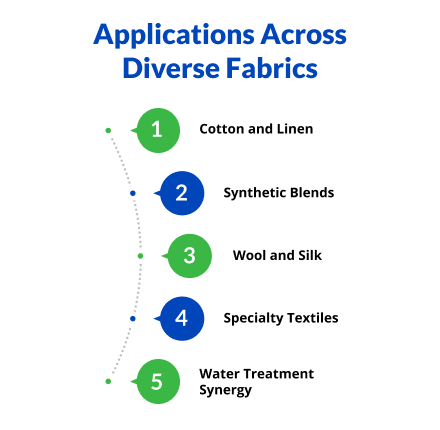
Cationic softeners perform well in most fibers and are therefore suitable for many export products. Cotton, which is a major component of the global textile trade, benefits from cationic fabric softener, which gives towels, bed sheets and apparel a buttery texture. And this is especially important in hospitality markets where softness drives customer satisfaction.
In the case of blends such as polyester-cotton, used in sportswear and casual clothing, cationic softeners provide softness with breathability. Wool and silk are often exported for luxury markets but retain their natural properties with enhanced drape and sheen.
Dosage is dependent upon fabric weight, normally 0.5-2%, without residue.
When compared to anionic or non-ionic softeners, cationic softeners offer distinct advantages for dyed fabrics. Anionic softeners are suitable for undyed goods but lack the strong bonding of cationics, which retain color very well.
Non-ionic softeners have a mild effect and fail to give the deep softness required for the prime exports. Cationic softeners are better rated in textile studies for softness and durability tests. But they need to be applied precisely, otherwise yellowing occurs under high heat.

Cationic softeners are effective but may cause foaming, dye incompatibilities or yellowing.
All these solutions are easily integrated into production lines with export quality.
At Colourinn we know that cationic softeners play a key role in the production of textiles that comply with world standards. They are soft, tough & color stable which is a must requirement for export markets.
From cationic softener flakes for batch processing to liquid cationic fabric softener for high-speed lines, all of our products are engineered for performance and eco-consciousness.
Find out how Colourinn tailor-made solutions can improve your textile production. Contact us for samples, technical support or a quote. Let’s create fabrics that will win over international markets with quality & comfort.
A. Cationic softeners are positively charged chemical agents applied in textile finishing to improve softness, smoothness, and flexibility of fabrics. They form a lubricating layer on fibers, enhancing comfort and durability for export-quality textiles.
A. Cationic softeners improve hand feel, reduce static cling, enhance color retention, and prevent pilling. They make fabrics softer and more durable—essential qualities for apparel and home textiles meant for global markets.
A. Modern cationic softeners are formulated to be biodegradable and eco-compliant with global environmental standards. Manufacturers like Colourinn develop sustainable solutions that balance performance with environmental responsibility.